Evaluation of the Bicycle Helmet Wearing Law in Victoria during its First Four Years
Carr D, Dyte D, Cameron M. Monash University Accident Research Centre Report 76, 1995.
Summary of original paper
The authors examined data on cyclists admitted to public hospitals. Corrections were applied for various factors, such as changes in hospital admission policies and road-safety related factors. Admissions in the first four years of helmet legislation were 40% below the number expected on the basis of pre-legislation trends. It was concluded that the helmet law had a significant effect in reducing the number and severity of injuries amongst bicyclists, and that this effect persisted for four years after the legislation.
BHRF Commentary
A previous analysis by the same organisation, based on 3 years post-law data for cyclists in collision with motor vehicles, found there was no difference in the percentage with head injury, compared to what would have been expected without the law. To illustrate why, numbers of hospital admissions are shown on the following graph; head injuries to cyclists are in blue and non-head injuries in red.
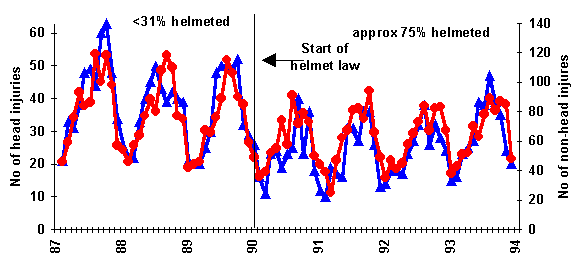
Report 76 claims that there was a substantial drop in head injuries with the law, as is clear from the graph. However, there was little discussion in the report of the substantial drop in non-head injuries. The graph shows both head and non-head injuries fell dramatically. Therefore, the effect of the law was mainly to discourage cycling, rather than prevent head injuries when crashes occurred.
Average annual numbers of Deaths and Serious Head Injuries (DSHI) and All Serious Injuries (ASI)
Source: Transport Accident Commission, Victoria |
| Period |
Cyclists |
Pedestrians |
| |
DSHI |
ASI |
%DSHI |
DSHI |
ASI |
%DSHI |
| Pre-law (1988-90) |
72.5 |
283.0 |
26.5% |
285.5 |
828.0 |
34.5% |
| Post-law (1990-2) |
41.0 |
165.0 |
24.8% |
211.0 |
660.0 |
32.0% |
Data from the Transport Accident Commission (above) allows the effect of the law to be examined in more detail, comparing data for cyclists and pedestrians injured by motor vehicles. In the first two years of the law, the percentage of serious injuries to cyclists resulting in death or serious head injury (%DSHI) fell by only 1.7 percentage points (from 26.5% to 24.8%). Over the same period, %DSHI for pedestrians (without helmets) fell by 2.5 percentage points. The gains in pedestrian safety are attributed to road safety campaigns to discourage speeding and drink-driving (introduced at almost the same time as the cycle helmet law). Assuming cyclists and pedestrians benefitted similarly from these campaigns, it is not possible to assign any positive outcome to the helmet law.
See also